FIREBUSTERS · DRIVING LIGHT COMPARISON
Bushranger Night Hawk ADV vs VLI vs VCT: which should you choose?
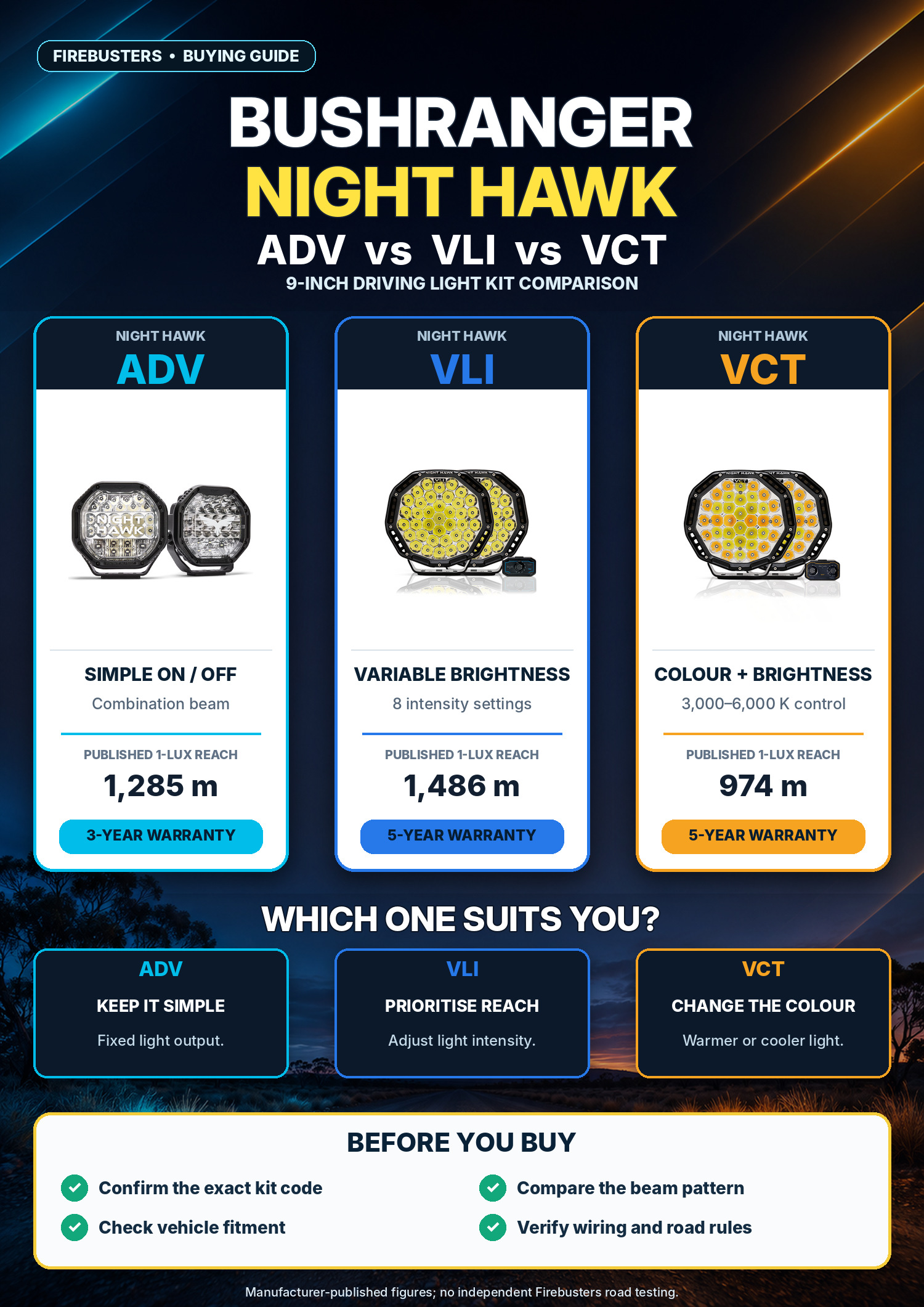
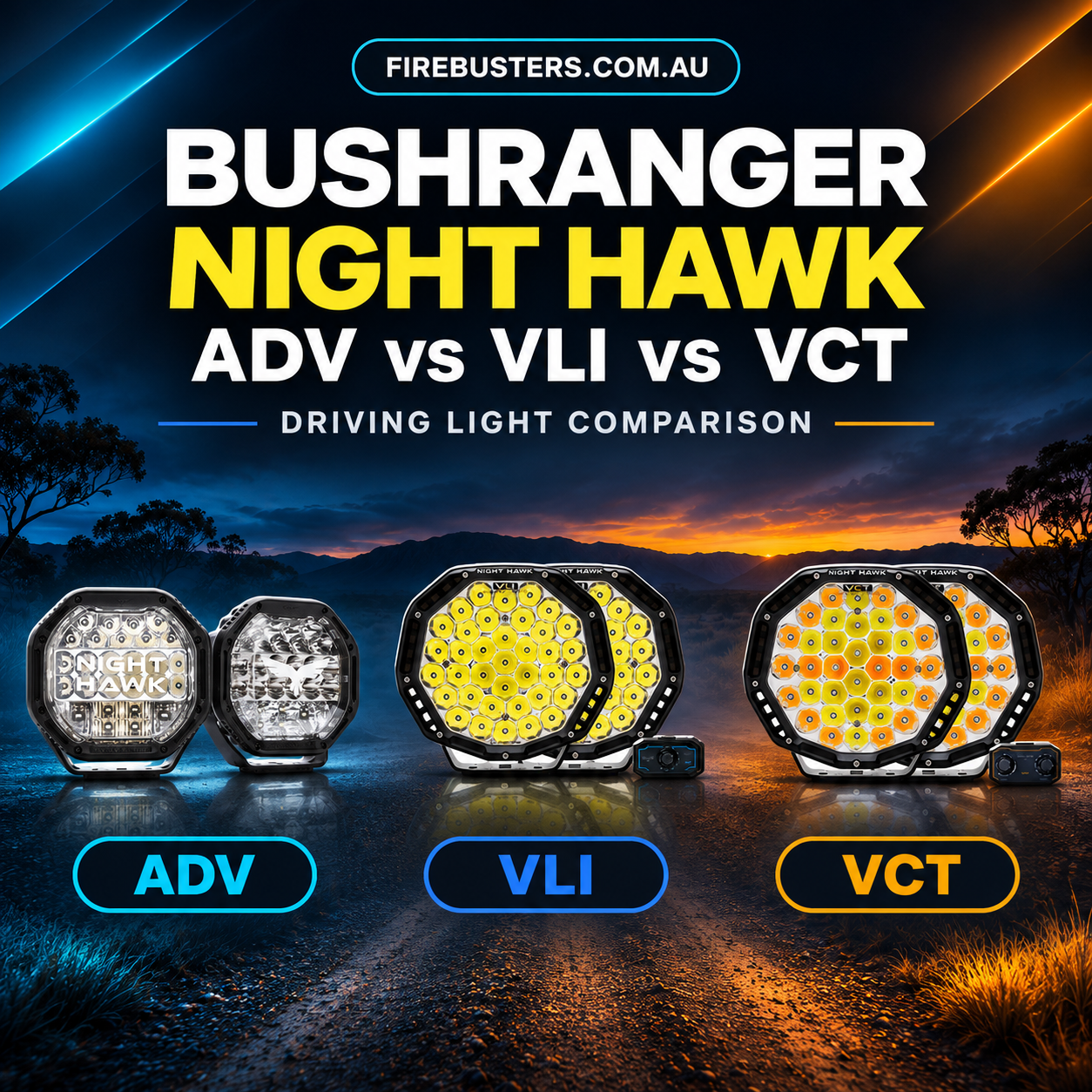
The three Bushranger Night Hawk 9-inch driving light kits look like close relatives, but they are designed around different priorities. The ADV keeps operation simple. The VLI lets you change brightness. The VCT adds adjustable colour temperature as well as brightness.
Quick verdict: Choose ADV if you value straightforward operation; shortlist VLI if adjustable brightness and long-distance illumination matter; consider VCT if controlling the light’s colour in changing conditions is a priority. These are buying recommendations based on published specifications, not personal road tests.
This Bushranger Night Hawk comparison is about more than finding the biggest lumen figure. A good setup needs to illuminate the road ahead without excessive reflection, fit securely to your vehicle, work with its electrical system and remain practical on long trips. It also needs to suit your driving: open highways, winding bush tracks and dusty touring routes call for different compromises.
Bushranger Night Hawk comparison at a glance
| Feature | Night Hawk ADV 9” | Night Hawk VLI 9” | Night Hawk VCT 9” |
|---|---|---|---|
| Model / kit code | NHA230AK | NHX230VLI-KIT | NHX230VCT-KIT |
| Controls | On/off | Adjustable brightness | Adjustable brightness and colour |
| Effective lumens, pair | 25,640 | 27,400 | 22,800* |
| Published distance at 1 lux | 1,285 m | 1,486 m | 974 m |
| Colour temperature | 5,700 K | 5,700 K | Adjustable 3,000–6,000 K |
| Total stated power | 369 W | 350 W | 340 W |
| Fitted kit weight | 5.9 kg | 7.2 kg | 7.2 kg |
| Advertised warranty | 3 years | 5 years | 5 years |
Source: Bushranger manufacturer’s 9-inch kit pages and Night Hawk range overview. Figures are published specifications, not Firebusters test results. Distance, brightness and cover configurations may differ between test methods. *Bushranger’s VCT materials also show 22,880 lumens elsewhere; confirm the figure for the exact kit before relying on it.
1. Bushranger Night Hawk ADV: the straightforward option
The Night Hawk ADV is designed for drivers who want substantial forward lighting without another dashboard control to manage. The 9-inch kit uses a fixed combination beam rather than an adjustable brightness system. Bushranger describes a mixture of reflector designs aimed at long-, medium- and short-range illumination.
Published figures for the 9-inch ADV kit are 25,640 effective lumens and a maximum 1-lux distance of 1,285 metres. The manufacturer quotes 369 watts and a 5,700 K white light. Those numbers give a useful starting point, but they do not tell you exactly how the road will look from your driver’s seat. Beam shape, aiming and the surrounding environment also matter.
What’s in the ADV kit?
Bushranger’s official 9-inch kit listing confirms two 9-inch LED lights, a 600 W plug-and-play wiring loom, mounting hardware and pairs of clear, blackout and frosted amber protective covers. That is more complete information than the original merchant summary, which left kit quantity and accessories uncertain.
The ADV’s powder-coated aluminium housing, stainless mounting components and impact-resistant polycarbonate lens are appealing on paper. Its stated 5.9 kg fitted weight is lower than the 7.2 kg figures published for the two Variable Series kits. Lower weight can be helpful when assessing mounting hardware and the front of a bull bar, but it is not evidence of better or worse durability by itself.
Important model check: The supplied My Generator ADV URL contains “7” in its address even though its title references a 9-inch kit. Before ordering, confirm the product code NHA230AK if the 9-inch ADV is what you intend to buy. The smaller 7-inch ADV is a separate product.
Bushranger Night Hawk ADV 9-inch kit
Check that the seller supplies model NHA230AK. The original merchant link contains mixed 7-inch/9-inch wording.
Bushranger Night Hawk VLI 9-inch kit
Confirm model NHX230VLI-KIT, including the single-dial controller and wiring system.
Bushranger Night Hawk VCT 9-inch kit
Confirm model NHX230VCT-KIT, with the dual-dial brightness and colour controller.
2. Bushranger Night Hawk VLI: adjustable brightness
VLI stands for Variable Light Intensity. Unlike the ADV, the VLI is built around a dial that changes brightness. That can be worthwhile when full light output is unnecessary or causes distracting reflections from road signs, vegetation or dust. It also gives drivers more flexibility between open-road touring and slower off-road tracks.
For the 9-inch VLI pair, Bushranger publishes 27,400 effective lumens, a 1-lux distance of 1,486 metres, 350 W total power and a fixed colour temperature of 5,700 K. The kit page describes eight brightness settings; the range overview describes seven settings plus off. Either way, its key benefit is adjustable intensity, not a changing beam pattern or colour temperature.
What’s in the VLI kit?
The official VLI kit includes two 9-inch lights, a plug-and-play relay-free wiring system, a single-dial controller, mounting hardware and protective spot and flood covers. The controller can operate up to four compatible VLI lights according to Bushranger. Check how you would position and connect that controller in your vehicle before installation.
Bushranger lists 37 OSRAM LEDs per light, an aluminium housing, hard-coated polycarbonate lens, 4 mm stainless brackets and active temperature monitoring. It also publishes IP67/IP69K ingress ratings and shock/vibration testing to SAE J575. These are manufacturer-stated features, not independent longevity findings from Firebusters.
3. Bushranger Night Hawk VCT: brightness plus colour control
VCT means Variable Colour Temperature. It extends the Variable Series idea by offering adjustable brightness and colour tone through a backlit dual-dial controller. The published range runs from about 3,000 K, which looks warmer or more amber, to 6,000 K, which looks cooler and whiter.
Why could that matter? A fixed cool-white beam may be effective on a clear highway, but some drivers prefer a warmer tone in dust or mist or when reflections become tiring. Colour choice is a personal and situational consideration, not a guarantee that the VCT will outperform another light in fog or make unsafe conditions safe.
Bushranger’s VCT kit page lists 340 W total power, 23.8 A at 14.4 V, a total fitted weight of 7.2 kg and 36 CREE LEDs per light. Its product specification shows 22,800 effective lumens; the broader manufacturer range page shows a slightly different number. The range overview also quotes a 974-metre distance at 1 lux. Treat these as published test figures, with the exact configuration and measurement notes checked before purchasing.
What’s in the VCT kit?
The official kit contains two 9-inch VCT lights, relay-free wiring with a dual-dial controller, mounting hardware and pairs of protective spot and flood covers. Bushranger says the controller can support up to four VCT lights. Like the VLI, the VCT has manufacturer-stated aluminium housings, 4 mm stainless brackets, lens protection, temperature management and IP67/IP69K ratings.
4. Which has the best light output?
If you look only at Bushranger’s published 9-inch pair figures, the VLI has the highest quoted effective lumens and the longest quoted 1-lux distance of these three kits. That makes it a sensible candidate for drivers prioritising reach. The ADV follows on those quoted measures, while the VCT’s selling point is its adjustable colour and brightness.
However, lumens are not the same as usable road illumination. Lumens describe total visible light output; a beam pattern determines where that light goes. A concentrated beam can provide longer distance while giving less visibility at the road edges. A broader beam can reveal bends, track shoulders and hazards closer to the vehicle.
A 1-lux distance is the point where measured illuminance drops to one lux under the test conditions. It is useful for comparison when measurement methods match. It does not mean a driver can safely recognise every hazard at that distance, especially with fatigue, wet roads, glare or poor visibility.
Also check whether quoted results include protective covers. Bushranger’s performance diagrams use model-specific cover conditions, so comparing one headline number against another without reading the test notes could give a misleading ranking. Ask the supplier for the current isolux diagrams and compare the shape of the beams as well as their distance.
5. Build quality, weather resistance and durability
Quality is more than how sturdy a light feels in your hand. For a 4WD, brackets must tolerate repeated vibration, lenses must resist damage and the housings must manage heat and moisture while exposed to the weather. The quality of wiring connections and the installation itself can also influence reliability.
Across these ranges, Bushranger describes die-cast aluminium housings, stainless-steel mounting brackets, protected polycarbonate lenses and electrical protection systems. Its specification pages reference ingress-protection ratings and shock/vibration standards. The ADV is listed as IP68/IP69K, while the VLI and VCT are listed as IP67/IP69K. These ratings describe tested resistance under specified conditions; they should not be read as permission to neglect seals, wiring or damaged fittings.
The VLI and VCT also advertise active temperature management. That matters because LEDs and electronics generate heat, particularly in enclosed light bodies. Heat-management design may support consistent operation, but we have not measured how long any of these kits maintain full output in Australian summer conditions.
6. Vehicle fitment and electrical installation
In any Bushranger Night Hawk comparison, vehicle fitment matters. Measure the usable space on your bull bar or other approved mount. Check the light diameter, overall depth, bracket footprint, clearance for adjustment and whether the lights obstruct existing lamps, the number plate, sensors or the driver’s forward view. Do not assume two products described as 9-inch will have identical external dimensions.
Bushranger publishes a specific fitment note for the Variable Series affecting some Ford Ranger PX variants, pre-2025 Volkswagen Amarok and Jeep Wrangler vehicles. If one of those applies to you, read the current fitment document and ask the supplier or installer about any required adaptor before ordering. Other vehicles may also need checks based on their wiring and mounting arrangement.
All three kits list wiring components, but that does not guarantee every vehicle needs no additional parts. Modern high-beam circuits can differ substantially. A competent auto electrician or specialist installer should confirm compatible high-beam activation, connectors, switching, wire protection, fusing and cable routing.
In Victoria, Transport Victoria states that additional driving lights must operate only with high beam and automatically go off when high beam is switched off. It also places conditions on the number, alignment and positioning of lights. Check current rules for your own state or territory before fitting them, particularly if you travel interstate.
7. Warranty and value for money
The advertised warranty is three years for the ADV and five years for both the VLI and VCT. A longer warranty is useful, but it does not prove a better-performing light. Ask for the written conditions, especially any exclusions relating to installation, modifications, impact damage or commercial use. Your rights under Australian Consumer Law also apply independently of any manufacturer’s voluntary warranty.
Compare the full installed cost, not just the price of the lights. The correct kit must include the right wiring and controls, and there may be charges for high-beam adaptors, fitting and aiming. The VCT’s extra colour control has little value if you would always leave it on one setting; equally, a driver who regularly wants a warmer beam may find that additional control worthwhile.
8. Which Bushranger Night Hawk kit should you buy?
Choose the ADV if: you prefer dependable, uncomplicated on/off operation, want a combination beam and have no strong reason to pay for a dashboard dimmer. Confirm that you are buying the 9-inch NHA230AK rather than the separate 7-inch version.
Choose the VLI if: brightness adjustment is valuable to you, long-distance performance is high on your list and you like the fixed 5,700 K colour. The manufacturer’s published output and distance figures make it particularly worth comparing for regular country-highway use.
Choose the VCT if: you want more control over how the light looks in varied conditions. Its adjustable warm-to-cool colour can be attractive for mixed touring environments, even though its quoted maximum distance is lower than the VLI’s.
Frequently asked questions
Are ADV, VLI and VCT all sold as pairs?
Yes. Bushranger’s official 9-inch kit pages specify two lights for each of these three kit part numbers. Be careful when comparing against separate single-light listings, and verify the part number at checkout.
Which model has adjustable brightness?
Both VLI and VCT have variable brightness controls. ADV is the straightforward on/off option. VCT additionally offers adjustable colour temperature; it is not the same as the separate VBP model, which is designed for adjustable beam pattern.
Is the VLI brighter than the VCT?
Its published effective-lumen and 1-lux-distance figures are higher. That supports a limited specification-based comparison, not an absolute claim that VLI provides better visibility in every driving situation. Beam shape and colour preference affect the experience.
Are more lumens always better for country driving?
No. Very bright lights can produce distracting reflections from signs, dust and nearby objects. A good balance of distance, width, aiming and suitable controls is usually more useful than chasing a single maximum output number.
Can I install the driving lights myself?
Some owners may be capable, but an incorrect connection can create safety and compliance problems. If you are unsure about high-beam integration, mounting strength, circuit protection or aiming, have a qualified automotive lighting installer do the job.
Does a five-year warranty mean VLI or VCT is tougher?
Not necessarily. It is a longer advertised warranty period, but claims about comparative service life would need long-term evidence. Confirm the written warranty terms and availability of replacement components.
Final pre-purchase checklist
- Check the exact 9-inch kit code: NHA230AK, NHX230VLI-KIT or NHX230VCT-KIT.
- Compare beam diagrams, light output and the manufacturer’s measurement conditions.
- Decide whether you need on/off, brightness adjustment or brightness plus colour control.
- Measure the mounting space and review the appropriate vehicle fitment notes.
- Confirm high-beam integration, wiring connections and any required adaptors.
- Allow for the complete installed cost, not just the lights’ advertised price.
- Read the warranty conditions and confirm the seller’s support arrangements.
Final verdict
For a simple, capable 9-inch kit, the ADV is worth a look. For controllable brightness and the strongest published reach of these three, start with the VLI. For drivers who value the additional warm-to-cool adjustment, the VCT offers the most flexible colour control. Check fitment and the correct kit contents before choosing.
Where to buy: check the current kits
These retailer links are provided for convenience. Confirm price, stock, kit code, light quantity, wiring, delivery and written warranty terms on the product page before ordering.
Sources and review limitations
This is an editorial buying guide based on publicly available manufacturer and retailer specifications. Firebusters has not road-tested or independently measured these lights. Figures may change as manufacturers update products. Refer to the current original documents before publication or purchase.
Bushranger: ADV 9-inch specifications · VLI 9-inch specifications · VCT 9-inch specifications · Night Hawk range comparison.
Affiliate disclosure
This comparison contains affiliate links. Firebusters may earn a commission if you buy through them, at no extra cost to you. Specifications are attributed to the manufacturer or retailer unless otherwise stated. We do not claim hands-on testing.