FIREBUSTERS AUSTRALIA • SMART BUYING GUIDE
Choose a pump for the job, not just the horsepower
Compare two petrol-powered pumps for rural water delivery, irrigation and bushfire preparedness.
Research-based buying guide • Reviewed 25 November 2026
Choosing firefighting pumps in Australia requires more than buying the largest engine or the highest advertised pressure. A pump is only one component of a water delivery system. The water source, hose sizes, elevation, fittings, operating conditions and intended use all affect whether the system can meet your needs.
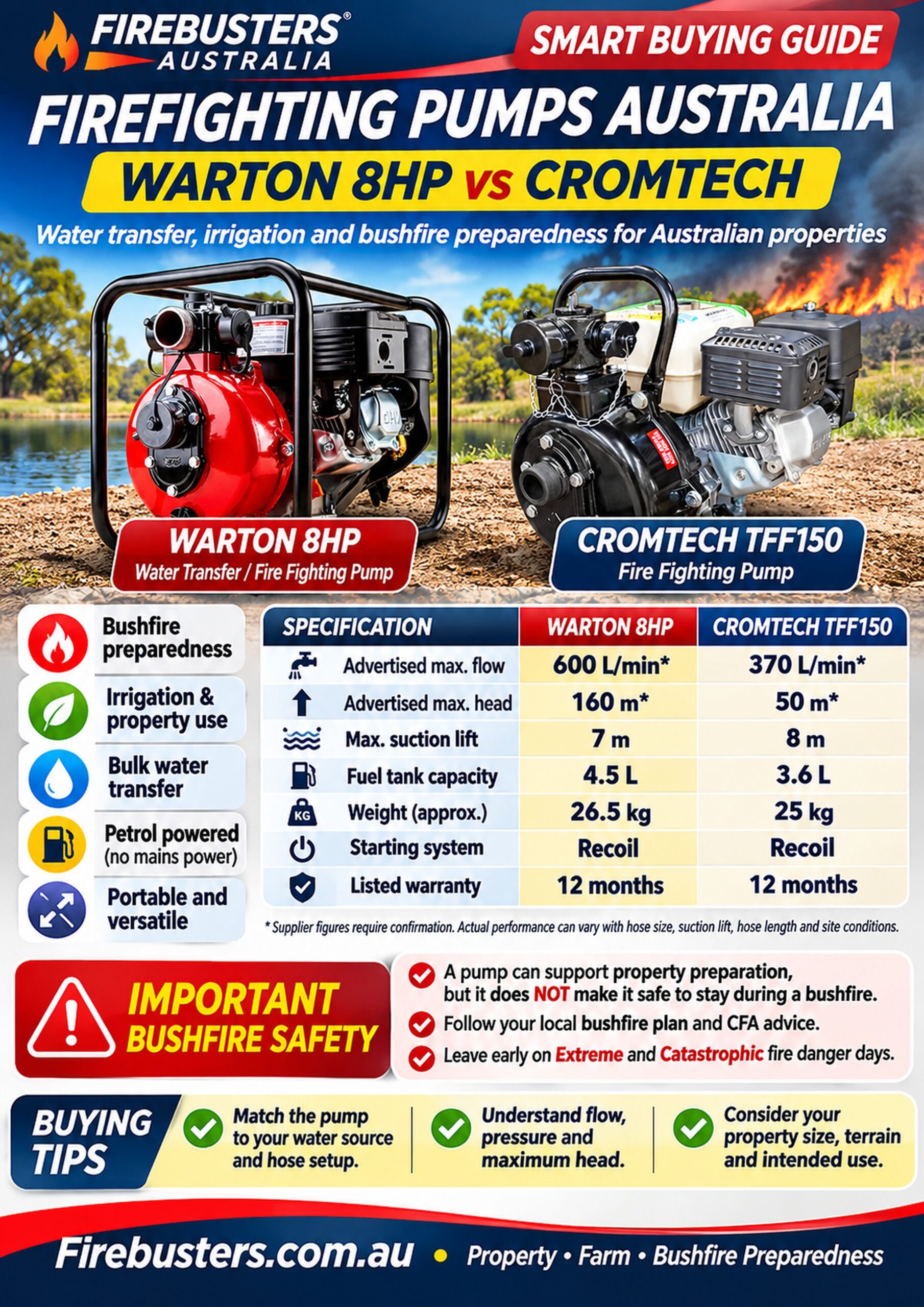
This guide compares the WARTON 8HP Pro-Series petrol pump (SKU PMPPTLPROB02P) with the Cromtech TFF150 single-impeller range. Both are marketed for pressurised water delivery, but the published information contains inconsistencies that buyers should resolve before ordering. We also consider when a dedicated transfer pump or professionally designed system makes more sense.
Affiliate disclosure: Firebusters may earn a commission if you purchase through the WARTON affiliate link at the end of this guide. The comparison is based on published information, not independent performance testing or hands-on use.
Life safety comes first
A petrol pump is not a guarantee of survival. Leave bushfire-prone areas early on high-risk days in accordance with official advice. Never plan to stay and defend on Catastrophic fire danger days. Do not delay leaving to operate, recover or refuel equipment.
Quick buying recommendation
Consider the WARTON if you need a portable high-pressure pump and its supplier can substantiate the performance at your required duty point. Consider Cromtech if local support, replaceable components and intermittent operation suit your needs. Neither is an unconditional recommendation for a life-critical installation.
WARTON vs Cromtech: specifications
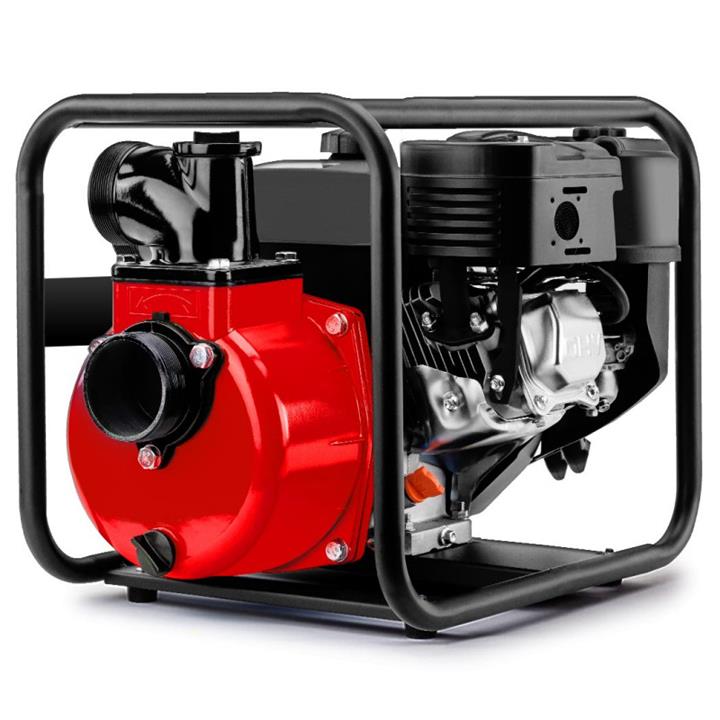
The WARTON listing identifies a 235cc four-stroke petrol engine and a centrifugal pump in a protective frame. Cromtech’s manufacturer page describes a single-impeller pump with replaceable suction and delivery ports. A single impeller is not automatically inferior to a multi-stage pump: the appropriate design depends on the water delivery requirement.
| Specification | WARTON PMPPTLPROB02P | Cromtech TFF150 |
|---|---|---|
| Engine | 235cc; advertised 8HP at 3600 rpm | Petrol; GP160DP in specification table; engine brand requires confirmation |
| Maximum flow | 36,000 L/h (600 L/min), supplier-listed | 370 L/min in specification table; description says 360 L/min |
| Maximum head / lift | 160m, supplier-listed; request evidence and curve | 50m in specification table; description says 60m |
| Maximum suction lift | 7m | 8m |
| Inlet | 1 × 50mm (2 in) | 1 × 40mm (1½ in) |
| Outlets | 2 × 40mm and 1 × 50mm in specification table | 1 × 40mm and 2 × 1 in |
| Fuel tank | 4.5L | 3.6L |
| Starting | Recoil | Recoil |
| Product weight | 26.5kg | 25kg |
| Listed standard warranty | 12 months | 1 year |
| Duty limits | Confirm with supplier | Manufacturer describes intermittent use |
Sources: Edisons and Crommelins, accessed 25 November 2026. The WARTON narrative refers to four outlets but its specifications identify three. The Cromtech narrative and table differ on flow, head and engine identification; the Honda-powered variant may have different ratings. Do not assume these variants are identical. All performance values are published claims, not measured results.
FIREBUSTERS AUSTRALIA • SMART BUYING GUIDE
Compare Firefighting Pumps
Explore two petrol-powered pump options for Australian properties.

WARTON 8HP Pro-Series
Petrol High-Pressure Water Pump
Consider for irrigation, water transfer and property preparedness where its verified pumping performance meets your requirements.
- 235cc four-stroke petrol engine
- 4.5L fuel tank
- Protective tubular steel frame
- Recoil starting system
- 12-month standard warranty listed
Check Price at Edisons
Affiliate link • Opens in a new tab

Cromtech TFF150
Honda-Powered Firefighting Pump
Consider this single-impeller alternative for intermittent water transfer, washdown and suitable property preparedness applications.
- Honda GP160 petrol engine
- 3.6L fuel tank
- Single impeller design
- 1.5-inch inlet and discharge
- 12-month warranty listed
Check Price at My Generator
Affiliate link • Opens in a new tab
Important bushfire safety reminder
Owning a firefighting pump does not make it safe to stay during a bushfire. Follow official fire authority advice and your bushfire survival plan.
Affiliate disclosure: Firebusters may earn a commission from qualifying purchases through these links. Confirm current specifications, suitability, prices and availability with the retailer before purchasing.
Ask for a pump performance curve
The WARTON’s advertised 160m head is unusually high for a portable petrol pump. Do not use it as a design assumption without supplier confirmation and a model-specific performance curve. Maximum head and maximum flow are not simultaneous operating conditions.
Understanding flow, pressure and head
Flow is the quantity of water delivered over time, usually expressed in litres per minute. Head expresses the energy available to move water, in metres of water column. Pressure is the force per unit area available at a point in the system. These terms are related but describe different aspects of pump performance.
For most centrifugal pumps, the maximum head is reached at or near zero delivery. Maximum flow occurs under relatively low resistance. A real installation operates between these extremes. A pump curve shows the relationship between head and delivered flow, allowing a specialist to assess the expected performance under actual conditions.
As water travels through hoses and fittings, friction reduces available pressure. A long or narrow hose, restrictive coupling, filter or nozzle can create substantial losses. An uphill destination adds static head. Suction-side restrictions, air leaks and falling tank levels may reduce performance further. A high advertised maximum flow does not establish useful water delivery at a distant outlet.
| Advertised feature | What it does not tell you |
|---|---|
| Maximum head | Available flow at a usable pressure |
| Maximum flow | Delivery at a distant or elevated outlet |
| Engine horsepower | Efficiency, durability or usable duty point |
| Number of outlets | Combined flow when outlets operate together |
| Maximum suction lift | Reliable priming under actual site conditions |
| Fuel tank size | Guaranteed runtime at the required load |
For a meaningful comparison, ask both suppliers for curves, rated speeds, operating limits and the permissible duty cycle. Explain the proposed water source, delivery distance and elevation. If the supplier cannot substantiate the required performance, do not buy on the assumption that a higher marketing figure will solve the problem.
Choosing a pump for your property
Tank filling and general water transfer
If your main job is moving a large quantity of water between nearby tanks with little elevation change, a high-flow transfer pump may offer better value than a high-pressure model. Compare the actual flow at your required head, along with energy use and the cost of suitable hoses. See our WARTON high-flow water transfer pump guide for another category of pump. Check any water extraction restrictions and permissions before drawing from natural waterways.
Irrigation and washdown
Sprinklers and irrigation systems may require specific pressures and flow rates. Drip systems may need regulation and filtration rather than high pressure. Ask an irrigation specialist to match the pump to the equipment, including the permissible pressure of hoses, valves and fittings. A pump marketed for firefighting is not necessarily a good match for every irrigation installation.
Rural property preparedness
Portable petrol pumps can provide water independently of the electricity grid, but their fuel, engine and water source can fail. Buyers needing a fixed, automated or long-duration installation should obtain professional design advice. Neither of these portable products has been independently established here as suitable for unattended or life-critical use.
Hoses, water supplies and system design
The pump purchase is often only part of the total cost. Allow for suitable suction and delivery hoses, compatible threads and couplings, strainers, secure connections, a stable operating location and service access. The WARTON supplier lists connectors and accessories; confirm their exact contents and whether any hose is included. Cromtech lists hose and trolley kits as optional.
- Ask the supplier to identify the correct suction hose, strainer and fitting types for the exact model.
- Confirm the pressure ratings of every component with a qualified pump supplier. Do not improvise adapters or use ordinary low-pressure fittings where they are unsuitable.
- Have the proposed water source and pump location assessed, including water quality, minimum water level and suction conditions.
- For permanent installations, ask about backflow prevention, local plumbing requirements and the effect on other water services.
- Request commissioning and performance testing of the assembled system under normal, safe conditions.
A pump that is suitable for clean water should not be treated as a trash pump. Sand, sediment and debris can damage components or obstruct the water supply. Confirm permitted solids and water quality with the supplier. Never pump fuel, chemicals or other liquids unless the equipment is specifically designed and approved for them.
Bushfire preparedness and personal safety
Bushfire preparation is a separate decision from pump selection. The CFA explains that staying to defend is demanding and dangerous, even when equipment and water are available. Leaving early offers the best prospect of survival. Its equipment guidance for people considering defence includes an independent water supply of at least 10,000 litres, protection of pumping equipment from radiant heat and suitable firefighting hoses. These are minimum planning considerations, not a guarantee of safety.
A mains water supply may lose pressure and mains electricity can fail. A petrol engine may also stop due to mechanical faults, fuel problems or heat exposure. A large tank alone cannot establish how long a usable supply will last; other demands and the system’s actual water delivery matter. Have a competent specialist assess the proposed installation before relying on it.
Do not let equipment change your decision to leave
Prepare well before fire season, follow official warnings and have a leaving-early plan. Never return to a threatened property to operate a pump. If there is an immediate threat to life or property, call Triple Zero (000) from a safe location.
Read the CFA guidance on defending property and FireRescue bushfire preparedness guide. The equipment recommendations do not authorise anyone to fight a bushfire or replace local fire authority instructions.
Safe operation and maintenance
A petrol engine introduces hazards of its own. Exhaust contains carbon monoxide, and hot engine surfaces or fuel vapour can cause burns and fires. Operate only outdoors in a suitable location away from enclosed spaces, doors, windows, combustible storage and other ignition risks. Use and maintain the equipment in accordance with the exact model manual.
- Check oil, fuel, hoses and fittings before operation. Do not use damaged or leaking equipment.
- Follow the manual’s priming requirements. Do not run a pump dry or outside its specified operating limits.
- Stop the engine and allow it to cool before refuelling. Use approved fuel containers and keep fuel away from ignition sources.
- Keep hands and clothing away from moving parts; use appropriate hearing and other protective equipment.
- Follow the manufacturer’s maintenance intervals and storage instructions. Arrange qualified repair rather than improvising modifications.
- Check current local fire restrictions before using petrol-powered machinery. Do routine servicing and testing well before high-risk days.
WorkSafe Victoria has reported serious burns involving refuelling portable petrol equipment. See its refuelling safety alert. In Victoria, consult CFA fire restriction guidance before operating machinery during restricted periods. Other jurisdictions have their own rules.
Which pump should you buy?
WARTON 8HP — consider for value-oriented portable pumping
A potentially attractive option when the actual duty point and included fittings are confirmed. Its unusually high head claim, conflicting outlet count and unverified continuous-duty performance make it important to obtain written clarification before purchase.
Cromtech TFF150 — consider for intermittent rural work
Replaceable ports, a published single-impeller design and a dealer network may be useful for buyers who value service support. Confirm the exact engine variant, current flow and head figures and duty limits. The manufacturer explicitly describes intermittent use.
For a dedicated high-pressure or continuous-duty installation, compare professionally specified alternatives rather than simply selecting the model with the larger advertised figure. Consider local service capability, parts availability, total delivered and installed cost, and suitability for the actual water demand. Read our Cromtech TFF150 product guide for additional context, while checking the current manufacturer specifications.
Pre-purchase checklist
Before you order
- ☐ Exact model and engine confirmed
- ☐ Performance curve and required duty point confirmed
- ☐ Permissible duty cycle and operating conditions confirmed
- ☐ Hoses, connectors and installation costs included in the budget
- ☐ Service support, warranty and spare parts checked
- ☐ Water source, fuel and safe operating location assessed
- ☐ Independent bushfire plan in place, without reliance on the pump
Frequently asked questions
Is the WARTON 8HP a suitable firefighting pump?
It is marketed for high-pressure water delivery and firefighting applications. Suitability depends on substantiated performance, the complete system and the intended duty. It is not a guarantee of protection in a bushfire.
Does 160m head mean water can be delivered 160m uphill at 600 L/min?
No. Maximum head and maximum flow are separate endpoints, not a combined delivery promise. Request a pump curve and professional assessment.
Can I use the same pump for irrigation and tank filling?
Possibly. Check the required flow, pressure, water quality and compatibility of the equipment. A dedicated transfer pump may be more suitable for high-volume, low-head work.
Are hoses supplied with the WARTON?
Edisons lists connectors and accessories. Confirm the precise package contents and hose requirements before purchase.
Can I run the Cromtech TFF150 continuously?
The manufacturer describes the range as suitable for intermittent use. Do not assume continuous operation is supported; check the exact engine and pump documentation.
Can a pump replace a bushfire survival plan?
No. Equipment can fail, and defending a property is dangerous. Follow official advice to leave early and do not plan to defend on Catastrophic days.
Sources and verification
- Edisons — WARTON model specifications and manual access
- Crommelins — Cromtech TFF150 product information
- CFA — equipment considerations for property defence
- CFA — bushfire safety and leaving early
- WorkSafe Victoria — portable petrol equipment refuelling
- CFA — current fire restriction guidance
Supplier specifications were compared on 25 November 2026. No independent pump tests, certification review or site assessment were performed. This is a consumer buying guide, not a firefighting procedure or installation design.
Where to buy
Check the exact model, latest specifications, delivery costs and availability before ordering. Confirm the conflicting specifications with the supplier first.
WARTON 8HP Pro-Series
SKU PMPPTLPROB02P — verify the performance curve, outlet configuration and intended application.
Check current price at Edisons
Affiliate link • Opens in a new tab
Cromtech alternative: View manufacturer information and find a dealer (direct, non-affiliate link).
Bushfire Preparedness Snapshot
Useful context for a fire-fighting water pump guide. These figures reflect household preparedness signals in Victorian bushfire-prone areas.
Bushfire plan status
CFA surveyA pump can support preparedness, but planning, leaving early when needed, and property readiness still matter.
Related preparedness figures
Selected stats| Measure | Figure | Why it matters |
|---|---|---|
| Have a bushfire plan | 60% | Shows planning is common, but not universal. |
| No bushfire plan | 40% | Large gap in household readiness. |
| Would delay leaving | 31% | Waiting too long can increase risk. |
| Did not feel adequately prepared | 24% | Preparedness around the home still needs work. |
| Would stay to protect property | 16% | Highlights the need for realistic planning and equipment. |
| Not showing concern | 50% | Complacency can reduce readiness actions. |