Not every job on the tools demands a torque wrench, but when precise clamping force matters, a reliable unit is worth its weight. The VEVOR 3/8-inch Drive Click Torque Wrench promises dual-direction precision in a single, sturdy package—offering busy home mechanics and tradies a way to avoid costly over-torquing mishaps or under-tightening dramas. ⚙️
Torque tools thrive on accuracy, not hype, and that’s why it’s crucial to choose sensibly for the tasks at hand.
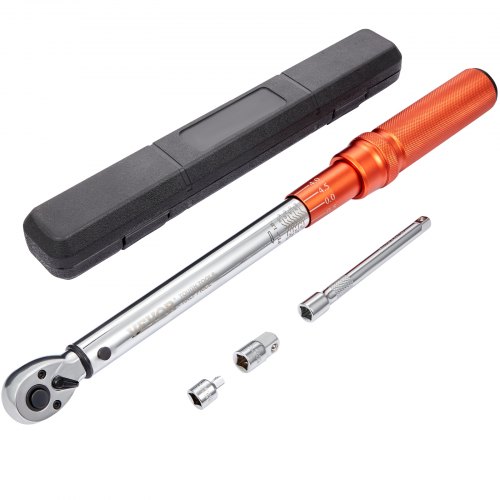
With its adjustable 10-80 ft.lb (14-110 Nm) range, the VEVOR is pitched as a versatile option for motorcycles, bikes, small engine repairs, and automotive maintenance where measured force is non-negotiable.
At a Glance: VEVOR Torque Wrench Kit
This is a mechanical click-type wrench with a 3/8-inch drive, suitable for lighter automotive and household duties. The unit covers a typical range for most medium torque jobs, providing both clockwise and counter-clockwise measurement—handy if you ever work with reverse-threaded fasteners. Its mechanical dual-range scale means you can set and read in either imperial (ft.lb) or metric (Nm), ideal if you find yourself working from diverse manuals.
Included in the kit are the torque wrench itself, adapters, and an extension rod—extras that expand its utility but may add setup steps for some tasks.
Who Will Get the Most Value—And Who Should Pass
✅ Ideal for: Home mechanics, hobbyists, apprentices, and anyone maintaining bikes, motorbikes, or the family car, especially where access is tight or non-standard fasteners pop up. If you regularly swap wheels, service cylinder heads, or maintain mid-sized engines, this range is most likely a fit. The included extensions and adapters also help when you need that extra reach or adaptability on awkward bolts.
🔥 Less suited to: Heavy-duty industrial environments or professional trade use all day long. If your work demands very high or very low torque settings outside the 10-80 ft.lb mark—think big diesel engines, truck hubs, or microelectronics—you’ll want to look elsewhere. Similarly, those needing digital ‘peak hold’ or data output will not find those functions here.
What to Double-Check Before You Buy
Every torque tool promises accuracy, but a few simple checks upfront will avoid disappointment or wasted return trips:
- Check that 3/8-inch drive fits your current sockets and ratchets—adapters help, but direct fit is always simpler.
- Consider if the 10-80 ft.lb (14-110 Nm) range covers your most common tasks, not just edge cases.
- If you’re using precise torque as per manufacturer spec (for warranty reasons or safety), ask the seller for calibration certificate details or how frequently calibration is advised for the unit.
- Inspect the grip and click mechanism in person if possible; these should provide a positive, audible feedback, not a vague or quiet snap.
First Setup and Getting Going Safely
Once your kit arrives, take time to familiarise yourself with the basics. Unpack all adapters and the extension rod. Read the included instructions—mechanical clickers are simple, but initial setup is not a time to rush, especially where torque matters for safety.
- Set the torque level by unlocking the handle, twisting to your desired setting on the dual scale, then locking it in place.
- Attach your chosen adapter or extension if needed, ensuring each is snug but not overtightened.
Only use the wrench when you need controlled force—never for removing stubborn or rusted bolts. Always listen and feel for the click: this is your cue to stop turning immediately.
Simple Habits for More Precise Results
Small rituals lead to consistently accurate results with any torque wrench:
- Turn slowly as you approach your set torque to avoid overshooting before the click engages.
- Always grip the handle at the centre—this preserves accuracy and minimises risk of ‘lever cheat’.
- Engage the tool perpendicular to the fastener; avoid using it at an angle.
- If using an adapter or extension, note that some setups can slightly affect actual delivered torque. Refer to good practice guides if your job is critical.
Caring for Your Tool Between Jobs
Like all precision gear, how you store and treat your wrench matters if you want years of faithful service:
After use, wind back the torque setting to its lowest value—this prevents internal spring fatigue. Wipe down the tool to remove grease and moisture. Store it in a dry, padded case out of direct sunlight. Never submerge, soak, or leave it in the boot of a car, as this can promote rust or throw calibration out of whack.
Regularly check for visible wear, and if it’s ever dropped, consider re-checking calibration, especially if working on safety-critical fasteners in future.
Common User Pitfalls (and How to Dodge Them)
- Using the torque wrench for loosening bolts—always use a standard ratchet for removal instead.
- Forgetting to reset the scale to minimum after use, risking spring drift.
- Overreliance on adapters or extensions for every job (use only if access demands it).
- Ignoring subtle click or feedback due to working in a noisy or awkward space—focus is key.
Quick Questions—Answered
Q: Is this kit calibrated out of the box?
If calibration status isn’t specified by the seller, ask before purchase or check if they provide a calibration certificate.
Q: Can I use this for both right- and left-hand threads?
Yes, its dual-direction design supports both thread types—always double-check you’re set up for the direction needed.
Q: What’s the biggest job it will handle?
The 10-80 ft.lb (14-110 Nm) range covers general automotive, bike, and small engine work but not heavy-duty truck hubs or construction duties.
Q: Does it require batteries?
No batteries are required—this is a fully mechanical click-style wrench.
Q: How often should I calibrate it?
As a rule of thumb, annually for moderate users, or sooner if dropped or used heavily. Check the manufacturer’s recommendations for best practice. 🔥
Final Word: Sensible, Reliable Torque on a Budget
The VEVOR Torque Wrench Kit stands out as a well-rounded choice for those who want accurate results without paying for pro-level extras they don’t need. It’s practical for home and light trade use, offers flexibility with adapters and extensions, and sticks to mechanical principles most can trust. Measure your needs, check your tools, and you’ll give every fastener the care—and clamping force—it deserves.
For anyone after a no-nonsense, dual-scale torque wrench that covers everyday repair and maintenance, this sensible kit is a smart first step.
About the author and safety review
Ken Walker
Former Station Officer and fire service educator
Fire and emergency service educator with 40 years of career and volunteer experience.
Qualifications: Associate Diploma of Applied Science in Fire Technology; Institute of Fire Engineers studies.
Author profileGeneral information only. Follow official warnings, local procedures and manufacturer instructions.