Testing statement: Firebusters has not personally tested these BAUMR-AG compactors or rammers. This comparison uses current supplier specifications and published product information. Specifications and inclusions can change, so check the current listing and manual before purchase or use.
BAUMR-AG Plate Compactor vs Tamping Rammer
The BAUMR-AG BCX-800 and BCX-750 are forward-moving plate compactors. The BRM-700 is a different type of machine: a petrol-powered tamping rammer.
That distinction matters more than simply comparing engine size or machine weight.
BCX-800 vs BCX-750 vs BRM-700
| Specification | BCX-800 | BCX-750 | BRM-700 |
|---|---|---|---|
| Machine type | Forward plate compactor | Forward plate compactor | Tamping rammer |
| Engine | 208cc, 7HP OHV 4-stroke | 196cc, 6.5HP 4-stroke | 196cc, 6.5HP OHV 4-stroke |
| Dry weight | 90kg | 85kg | 81kg |
| Published operating mass | 111kg with full tanks | 94kg maximum operational mass | Not clearly published in current detailed specification |
| Plate / shoe | 545 × 400mm plate | 420 × 540mm plate | 285 × 345mm shoe |
| Published force | 13kN centrifugal force | 13kN centrifugal force | 10kN published output |
| Frequency / impacts | Up to 5,500 vpm | Up to 5,500 vpm | 450–680 impacts/min published; other supplier copy states up to 650 |
| Fuel tank | 3.6L | 3.6L | 2.8L |
| Water system | 14L sprinkler tank | 13L sprinkler tank | Not applicable |
| Transport aid | Fold-away wheels and lifting point | Fold-away wheels and lifting point | Detachable transport wheel kit and central lifting point |
BAUMR-AG BRM-700 Tamping Rammer

196cc 6.5HP Petrol Tamping Rammer
A petrol-powered tamping rammer with a 285 × 345mm shoe, 10kN published output, 196cc four-stroke engine and detachable transport wheel kit.
Check BRM-700 Price & Availability →
Sponsored affiliate link. Availability can change.
BRM-700 Verified Specifications
- Model: BRM-700
- SKU: COMRMRBMW7CA
- Type: Tamping rammer
- Engine: 196cc 6.5HP OHV four-stroke petrol
- Starting: Manual recoil
- Fuel: Regular unleaded, 95+ RON
- Fuel tank: 2.8L
- Shoe: 285 × 345mm
- Published output: 10kN
- Published impact rate: 450–680 impacts per minute
- Other supplier wording: up to approximately 650 beats per minute
- Published leap height: up to 65mm
- Published travel speed: approximately 11–14m/min
- Product dimensions: approximately 41 × 34 × 120cm
- Dry weight: approximately 81kg
- Transport: removable wheel kit supplied
- Lifting: central lifting point incorporated in frame
Why Does the Product Title Say 77kg?
The current supplier title describes the BRM-700 as a 77kg rammer.
However, the detailed product specification lists the machine’s dry weight as 81kg.
Impact-Rate Figures Also Conflict
The detailed specification lists an impact-rate range of 450–680 impacts per minute.
Elsewhere on the supplier page, promotional copy describes the rammer as operating at up to approximately 650 beats per minute.
This difference is relatively small, but buyers who need an exact design value for a specified compaction procedure should check the current machine manual rather than relying on retailer copy.
Where a Tamping Rammer Makes Sense
A tamping rammer has a much smaller working footprint than a plate compactor.
That can make the BRM-700 relevant to applications such as:
- trenches
- narrow excavations
- areas around posts or columns
- areas around services or pipes where clearance permits
- small reinstatement areas
The supplier also lists soil, sand, gravel, aggregate and asphalt among possible materials.
However, that should not be interpreted as a guarantee of a particular density or finished compaction result.
The correct machine and number of passes depend on the material, moisture content, layer thickness and engineering or project specification.
Rammer vs Plate on Cohesive and Granular Material
As a general equipment-selection principle, the concentrated vertical action of a tamping rammer can be useful on confined fills and cohesive material.
Forward plate compactors are commonly selected for broader granular bases because their larger footprint can cover open areas more efficiently.
There are many exceptions.
Do not use this rule of thumb as a substitute for the compaction specification on engineered fill, foundations, pavement work or regulated construction projects.
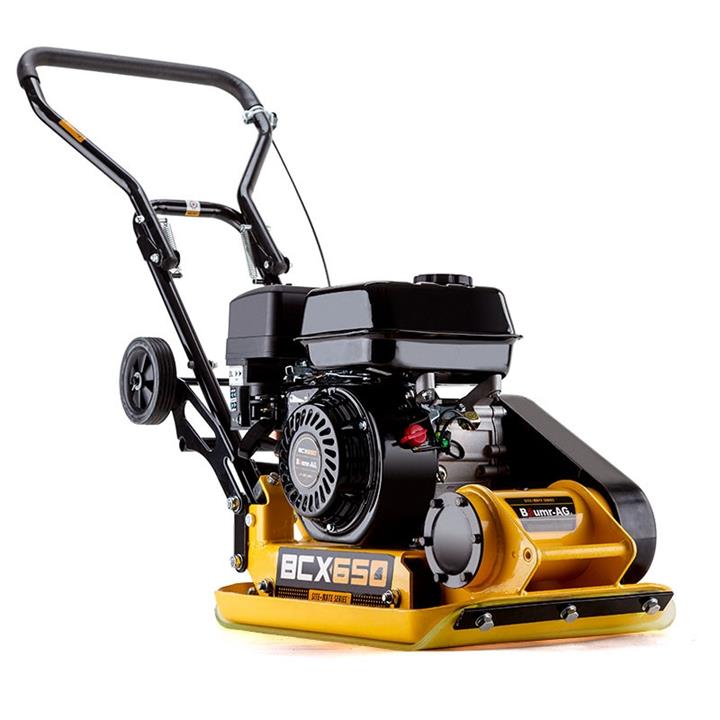
BAUMR-AG BCX-800 Plate Compactor
BCX-800 · 208cc · 13kN
The BCX-800 is the heavier of the two forward plate compactors in this comparison.
- Engine: 208cc 7HP OHV four-stroke
- Dry weight: 90kg
- Operating mass: up to 111kg with full tanks
- Plate: 545 × 400mm
- Centrifugal force: 13kN
- Frequency: 5,500 vibrations/min
- Fuel tank: 3.6L
- Water tank: 14L
- Published walk speed: 15m/min
- Sprinkler system: Yes
- Transport: fold-away wheels and lifting hook
BAUMR-AG BCX-750 Plate Compactor
BCX-750 · 196cc · 13kN
The BCX-750 retains the same published 13kN centrifugal-force figure but uses a different plate size and has a lower dry weight.
- Engine: 196cc 6.5HP four-stroke
- Dry weight: 85kg
- Maximum published operating mass: 94kg
- Plate: 420 × 540mm
- Centrifugal force: 13kN
- Frequency: up to 5,500 vibrations/min
- Fuel tank: 3.6L
- Water tank: 13L
- Sprinkler system: Yes
- Paver protection pad: Supplied
- Transport: fold-away wheels and lifting points
What Does 13kN vs 10kN Actually Tell You?
The BCX-800 and BCX-750 both publish a centrifugal-force rating of 13kN.
The BRM-700 publishes 10kN.
Those figures should not be used by themselves to decide which machine will compact better.
The machines apply energy differently:
- the plate compactors distribute vibration across a broad steel plate
- the rammer repeatedly drives a much smaller shoe vertically into the surface
Material type, lift depth, moisture and required density matter more than simply choosing the largest force number.
Asphalt and Sprinkler Systems
Both plate compactors include water sprinkler systems.
The BCX-800 uses a 14L water tank and the BCX-750 a 13L tank.
The supplier states that these systems help reduce hot asphalt sticking to the base plate.
The BRM-700 does not use an equivalent plate sprinkler system.
Although BAUMR-AG lists asphalt among BRM-700 applications, suitability still depends on the specific repair and compaction procedure being used.
Paving
The BCX-750 includes a protective paver pad.
This gives it an obvious practical advantage where a compatible plate compactor is required over installed pavers.
The BRM-700’s concentrated shoe action should not be treated as an alternative to a broad paver pad simply because both machines compact material.
Machine Width and Access
Check the actual working dimensions before ordering equipment for a narrow site.
- BRM-700 shoe: 285 × 345mm
- BCX-800 plate: 545 × 400mm
- BCX-750 plate: 420 × 540mm
The rammer has the smallest ground-contact area, but remember that the complete BRM-700 machine is approximately 41cm wide and 120cm high.
Allow clearance for the handles, operator position and safe machine movement rather than measuring only the shoe.
Transport and Manual Handling
These are heavy machines.
The BRM-700 is approximately 81kg dry, the BCX-750 approximately 85kg dry and the BCX-800 approximately 90kg dry.
The BRM-700 includes a central lifting point and removable wheel kit.
The BCX models also include transport wheels and designated lifting points.
Follow the manufacturer instructions before lifting any machine by crane or other mechanical equipment.
Petrol Engine Safety
All three machines in this comparison use petrol engines.
Never operate petrol-powered equipment inside enclosed or poorly ventilated areas because exhaust gases can contain dangerous carbon monoxide.
Also:
- allow the engine to cool before refuelling
- keep fuel away from ignition sources
- check for fuel leaks
- keep the engine and exhaust clear of combustible debris
- follow the manufacturer’s fuel and oil requirements
Noise and Vibration
Compaction machines expose the operator to significant mechanical vibration and noise.
Features such as vibration-isolated handles may improve comfort but do not prove that prolonged exposure is safe.
For regular workplace use, assess actual noise and vibration exposure and use suitable controls, work-rest cycles and PPE.
Before Starting Work
- Confirm the correct machine for the soil or pavement specification.
- Check underground and nearby services.
- Inspect the machine for damage, loose fasteners or leaks.
- Check engine oil and fuel levels.
- Check the plate, shoe, bellows and protective frame.
- Confirm handles and transport wheels are secured for operation.
- Wear suitable eye, hearing and foot protection.
- Keep other people clear of the operating area.
- Maintain safe footing and avoid unstable excavation edges.
Which Machine Should You Investigate?
| Job characteristic | Machine type to investigate | Reason |
|---|---|---|
| Large open granular base | BCX-750 or BCX-800 | Broad plate provides more efficient area coverage |
| Narrow trench or confined fill | BRM-700 | Smaller shoe and vertical rammer action |
| Paver work requiring protective pad | BCX-750 | Paver protection pad is included |
| Asphalt plate work | BCX-750 or BCX-800 | Integrated water sprinkler systems are provided |
Important: These are comparison starting points, not engineering specifications. For structural fill, pavements, footings or other engineered construction, follow the project’s specified compaction method and density requirements.
Frequently Asked Questions
Is the BRM-700 a plate compactor?
No. It is a tamping rammer. It uses a relatively small shoe and repeated vertical impacts rather than a broad vibrating plate.
Does the BRM-700 weigh 77kg?
The product title currently says 77kg, but the detailed BAUMR-AG specification lists a dry product weight of approximately 81kg. Firebusters recommends using the 81kg figure when planning transport and handling.
What size is the BRM-700 shoe?
Approximately 285 × 345mm.
What is its impact force?
The supplier publishes a 10kN output figure.
What is the BRM-700 impact rate?
The detailed specification lists 450–680 impacts per minute, while other supplier wording says up to approximately 650. Check the current manual if an exact figure is critical.
What engine does it use?
A 196cc 6.5HP OHV four-stroke petrol engine.
Which plate compactor is heavier?
The BCX-800 has a dry weight of approximately 90kg compared with approximately 85kg for the BCX-750.
Do both plate compactors have the same published force?
Yes. Both are currently listed at 13kN centrifugal force.
Does the BRM-700 include transport wheels?
Yes. A removable transport wheel kit is currently supplied.
Which model includes a paver pad?
The BCX-750 currently includes a protective paver pad.
Final Assessment
The BCX-800, BCX-750 and BRM-700 should not be treated as three versions of the same machine.
The BCX-800 is a 90kg dry forward plate compactor with a 545 × 400mm plate, 13kN centrifugal force and 14L sprinkler system.
The BCX-750 weighs approximately 85kg dry, uses a 420 × 540mm plate, also publishes 13kN force and includes a paver protection pad.
The BRM-700 is an 81kg dry tamping rammer using a 285 × 345mm shoe, 10kN published output and repeated vertical impact rather than plate vibration.
Firebusters recommendation: choose between a plate compactor and tamping rammer according to material, access and the compaction specification. For open granular bases, a plate is often the more efficient starting point. For narrow or confined fills where rammer action is specified or advantageous, the BRM-700 is the model to investigate.
Research Sources
-
Edisons – BAUMR-AG BCX-800
-
Edisons – BAUMR-AG BCX-750
-
Edisons / Commission Factory – BAUMR-AG BRM-700
Specifications, availability, package contents and supplier wording can change. Confirm important dimensions, operating limits and project suitability using the current machine manual and project specification.
About the author and safety review
Ken Walker
Former Station Officer and fire service educator
Fire and emergency service educator with 40 years of career and volunteer experience.
Qualifications: Associate Diploma of Applied Science in Fire Technology; Institute of Fire Engineers studies.
Author profileGeneral information only. Follow official warnings, local procedures and manufacturer instructions.